

If you’ve ever stood on a factory floor watching a gear pump hum quietly while moving molten plastics, adhesives, or industrial fluids, you might not notice the tiny, invisible force that shapes every part of its performance: fluid viscosity. As a supplier of motor gear pumps, I’ve spent years walking customers through this often misunderstood relationship—one that can make the difference between a production line that runs smoothly and one that grinds to a halt mid-shift. Today, let’s break down how viscosity impacts every part of a gear pump’s function, and why getting this right is non-negotiable for your operations.
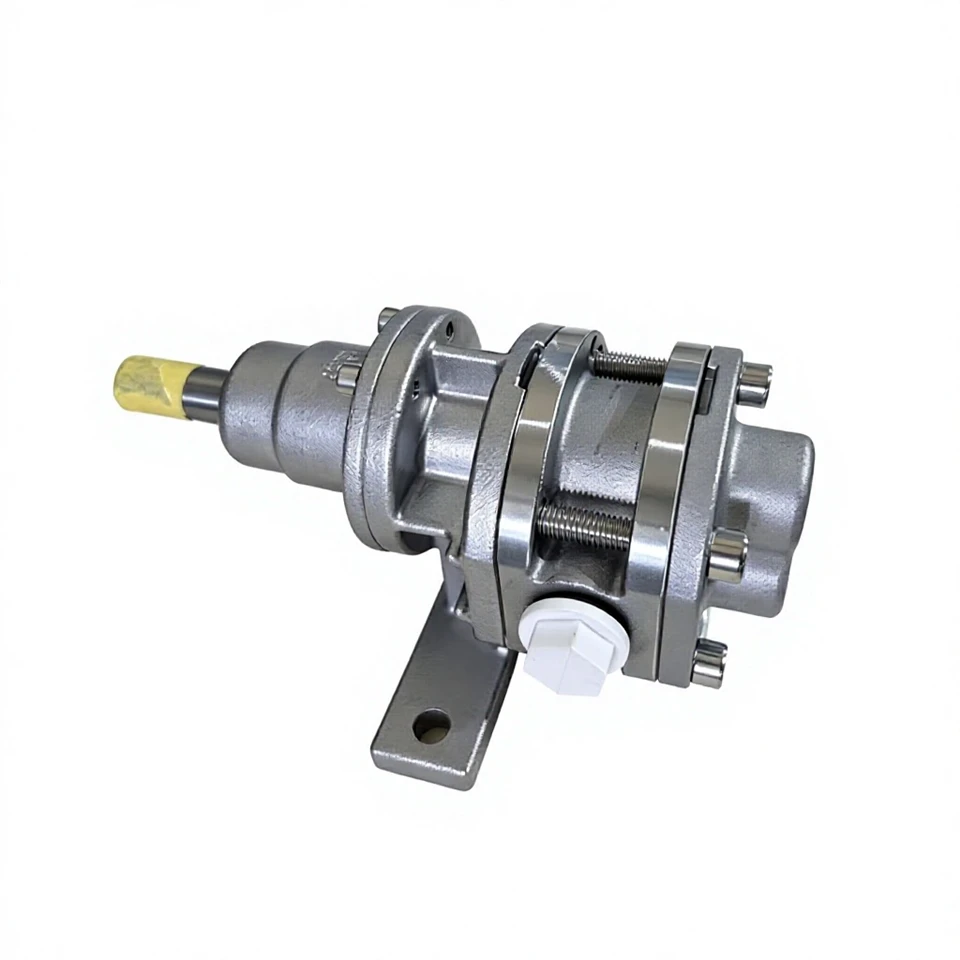
First, let’s ground ourselves: a motor gear pump works by trapping fluid between two interlocking gears (a drive gear connected to the motor and an idler gear) as they rotate. That fluid is carried from the suction side of the pump to the discharge side, where it’s pushed out at a set pressure. The space between the gear teeth, the pump housing, and the tips of the gears is so small (usually a few thousandths of an inch) that there’s almost no room for slippage. That’s where viscosity steps in. Viscosity is, simply put, a fluid’s resistance to flow—think of honey (high viscosity) vs. water (low viscosity), or the way cold motor oil thickens in winter and thins in summer.
For most gear pump applications, especially in industries like polymer processing, adhesives manufacturing, and extrusion, viscosity is the secret to both prime performance and reliability. Let’s start with the core function: volumetric efficiency. This is the percentage of fluid that actually makes it from suction to discharge without leaking back through the tiny gaps between moving parts. If you’re moving a high-viscosity fluid like molten polyurethane or structural adhesive, that thick fluid acts like a seal between the gears and the housing. It fills those micro-gaps, so very little slips back, and volumetric efficiency stays high—often 90% or more, which means you get exactly the flow rate you designed for. For example, our Polyurethane Glue Pump Stainless Steel Gear Metering Pump (link: /gear-pump/universal-gear-pump/polyurethane-glue-pump-stainless-steel-gear.html) is engineered specifically for these thick, sticky fluids, and we often tell customers that the right viscosity here is what lets it deliver consistent, repeatable flow batch after batch.

But flip that: if the fluid is too low in viscosity—like a thin solvent or cold water—those micro-gaps don’t hold enough fluid to act as a seal. Slippage becomes a huge problem. The gears rotate, but instead of carrying every last drop of fluid from suction to discharge, a large amount leaks back through the gaps. Volumetric efficiency can drop to 60% or lower, which means your flow rate is way off from what you expected. We see this most often with customers who try to use a general-purpose gear pump for ultra-thin fluids without adjusting for the lack of viscosity. That’s why our High Precision Gear Metering Pumps (link: /gear-pump/universal-gear-pump/high-precision-gear-metering-pumps.html) are built with tighter tolerances and optional seal upgrades for low-viscosity applications, to minimize that slippage.
Next up: pressure generation. A gear pump’s job is to build enough pressure to move fluid through pipes, filters, or downstream equipment. Viscosity directly impacts how much pressure the pump can produce. High-viscosity fluids require more force to move, so they create more resistance in the discharge line—and that means the pump’s pressure needs to be higher to overcome it. Because the thick fluid acts as that seal we talked about, the pump can generate enough pressure without much leakage. For example, when you’re processing meltblown polymer for face masks, the fluid’s high viscosity lets our Melt Blown Pump (link: /gear-pump/universal-gear-pump/melt-blown-pump.html) build the consistent, high pressure needed to spin the polymer into fine, uniform fibers. If that polymer was thinner, the pressure would bleed off through the gaps, and the fibers would be uneven or too thick.
On the other end, low-viscosity fluids create less line resistance, so the pump might run at lower pressure. But here’s where it gets tricky: if the fluid is too thin, even at low pressure, the gear pump can suffer from cavitation. Cavitation happens when pressure drops too much on the suction side, causing vapor bubbles to form in the fluid. Those bubbles collapse violently when they reach the higher pressure discharge side, eroding gear and housing material over time. Low-viscosity fluids have a lower boiling point (in pressure terms), so cavitation is much more likely. We often advise customers running low-viscosity fluids to use a pump with a larger suction port to reduce pressure drop, and to pair it with a flow control system that matches the pump’s capacity to the fluid’s viscosity.
Then there’s energy consumption. Running a gear pump is all about efficiency, and viscosity plays a big role here. High-viscosity fluids mean the pump’s motor has to work harder to move the thicker fluid, right? But wait—if you have a fluid that’s just the right viscosity for the pump’s design, you don’t have to compensate for leakage or pressure losses, so the energy used is actually optimized. For example, an Extrusion Gear Metering Pump (link: /gear-pump/universal-gear-pump/extrusion-gear-meteirng-pump.html) is sized for the viscosity of the extrusion resin it’s handling. If the resin is too thick, you need a higher power motor, more torque, and there’s more wear on the gear teeth from pushing against the fluid’s resistance. If it’s too thin, the pump wastes energy pushing fluid that’s slipping back instead of moving it forward. We see this with extrusion shops all the time: switching to a pump matched to their resin’s viscosity cut their energy bills by up to 15% in some cases, just by eliminating wasted energy from slippage.
Wear and tear is another critical factor. The tiny gaps in a gear pump mean that when there’s no fluid to act as a lubricant (which happens if viscosity is too low), the gears and housing can rub together, causing metal-on-metal wear. That leads to premature pump failure, inconsistent flow, and costly downtime. High-viscosity fluids, by contrast, provide a natural lubricating film between moving parts, reducing wear. Our Structural Steel Adhesive Gear Metering Pump (link: /gear-pump/universal-gear-pump/structural-steel-adhesive-gear-metering-pump.html) is built with hardened steel gears and a precision-machined housing, designed to work with the high viscosity of structural adhesives. We’ve had customers run these pumps for years without replacing parts, just because the adhesive’s viscosity keeps the gears lubricated. But if a customer tries to run a thin oil through that same pump, the lubrication film breaks down, and gears start to wear out in a matter of months.
I want to be clear: there’s no one “ideal” viscosity for all gear pumps. It depends on the pump’s design, the application, and the fluid you’re moving. For example, a pump designed for high-viscosity adhesives won’t work well for water, and vice versa. That’s why as a supplier, we spend so much time talking to customers about their specific fluids and processes. I’ve had a customer come to me last year with a extrusion line that was producing inconsistent plastic sheeting—turns out they’d switched to a thinner resin without adjusting their pump, so slippage was causing flow rate to vary by 10%. We helped them select a High Precision Gear Metering Pump with tighter tolerances, and they got consistent flow back within a week. Another customer was running a polyurethane glue line that kept overheating; we checked their pump, and they were using a pump sized for a lower-viscosity fluid, so the motor was working too hard to push the thick glue. We swapped in the Polyurethane Glue Pump Stainless Steel Gear Metering Pump, and their energy use dropped and overheating stopped.
Common mistakes I see customers make: first, assuming that a “one-size-fits-all” gear pump works for any fluid. Second, not accounting for temperature changes, because viscosity drops as fluid warms up. For example, a pump might work perfectly at room temperature, but when the fluid is heated to process it, it becomes thinner, leading to slippage. That’s why we always ask customers about the operating temperature of their fluid—we can adjust the pump’s clearances to compensate for viscosity changes due to heat. Third, ignoring line size and pressure drop. Even if your pump is matched to your fluid’s viscosity, if your suction line is too small, pressure will drop, and low-viscosity fluid will cavitate. We work with customers to map out their entire system, not just the pump, to make sure everything works together.
So what does this mean for your operations? If you’re relying on a gear pump to keep your production running, viscosity isn’t just a technical detail—it’s a core performance driver. Matching your pump to the viscosity of your fluid will boost volumetric efficiency, ensure consistent pressure, reduce energy costs, and extend the life of your equipment. If you’re not sure which pump is right for your specific viscosity and application, don’t guess—reach out to a supplier who can walk you through the details. Whether you’re handling meltblown polymers, extrusion resins, polyurethane adhesives, or structural steels, there’s a gear pump engineered to match your fluid’s viscosity. To discuss your exact requirements and find the right solution for your operations, feel free to connect with us for a procurement consultation.
References
- Melling, J. (2012). Fluid Power Pumps and Motors: Principles, Design, and Application. CRC Press.
- Wilson, E. A., & Smith, K. (2019). "Viscosity Effects on Gear Pump Volumetric Efficiency for Industrial Fluids." Journal of Manufacturing Processes, 45, 789-797.
- American Gear Manufacturers Association (AGMA). (2021). Standard for Gear Pump Performance Testing. AGMA 920-A21.
- Garcia, R., & Lopez, M. (2020). "Cavitation in Low-Viscosity Gear Pumps: Causes and Mitigation Strategies." International Journal of Fluid Machinery and Systems, 13(2), 112-120.





