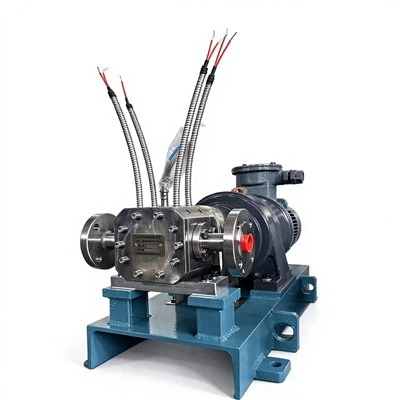
Hey there! As a gear pump supplier, I often get asked about various aspects of gear pumps. One question that pops up quite frequently is, "What is the displacement of a gear pump?" Well, let's dive right into it and break it down in simple terms.
Understanding Gear Pump Basics
Before we talk about displacement, let's quickly go over how a gear pump works. A gear pump is a type of positive displacement pump. It uses the meshing of gears to pump fluid. There are two main types: external gear pumps and internal gear pumps. In an external gear pump, two external gears mesh together. As the gears rotate, they create pockets of fluid at the inlet side. These pockets move the fluid from the inlet to the outlet as the gears turn. In an internal gear pump, there's an outer gear and an inner gear, and the same principle of creating fluid pockets applies.
What is Displacement?
The displacement of a gear pump is the volume of fluid that the pump can move in one complete revolution of the gears. It's usually measured in cubic inches per revolution (in³/rev) or cubic centimeters per revolution (cm³/rev). Displacement is a crucial characteristic of a gear pump because it directly affects the pump's flow rate.
Let's say you have a gear pump with a displacement of 1 in³/rev. If the pump rotates at 100 revolutions per minute (RPM), the theoretical flow rate would be 100 in³/min. But in the real world, there are some losses due to factors like leakage between the gears and the pump housing, so the actual flow rate will be a bit less than the theoretical value.


Factors Affecting Displacement
There are several factors that can influence the displacement of a gear pump.
Gear Size
The size of the gears plays a significant role. Larger gears generally have a larger displacement because they can create bigger fluid pockets. For example, if you compare a small gear pump used in a precision metering application with a large industrial gear pump, the industrial one will likely have a much larger displacement due to its bigger gears.
Gear Tooth Profile
The shape of the gear teeth also matters. Different tooth profiles can affect how much fluid is trapped between the teeth and how efficiently it's moved from the inlet to the outlet. Some tooth profiles are designed to minimize leakage and maximize displacement.
Pump Clearances
The clearances between the gears and the pump housing are crucial. If the clearances are too large, there will be more leakage, which reduces the effective displacement. On the other hand, if the clearances are too small, the gears may bind, causing excessive wear and potential damage to the pump.
Importance of Displacement in Different Applications
The displacement of a gear pump is important in various applications.
Industrial Applications
In industrial settings, gear pumps are used for transferring fluids like oils, chemicals, and fuels. A pump with the right displacement is needed to ensure that the correct amount of fluid is delivered at the required pressure. For example, in a hydraulic system, the displacement of the gear pump determines how fast the hydraulic cylinders can move. If the displacement is too low, the system may not operate efficiently, and if it's too high, it can cause excessive pressure and damage to the components.
Metering Applications
In metering applications, where precise amounts of fluid need to be dispensed, the displacement of the gear pump is critical. Our Magnetic Drive External Gear Metering Pump is designed with high precision to ensure accurate metering. The displacement of this pump is carefully calibrated to deliver the exact volume of fluid per revolution, making it ideal for applications like chemical dosing and food processing.
Corrosive Fluid Handling
When dealing with corrosive fluids, a pump with the right displacement is essential. Our Corrosion Resistant Metering Pump is built to handle aggressive chemicals. The displacement of this pump is optimized to provide a reliable flow rate while ensuring the pump's durability in corrosive environments.
Selecting the Right Displacement
When choosing a gear pump, it's important to select the right displacement for your application. Here are some steps to help you make the right choice.
Determine the Flow Rate Requirement
First, figure out how much fluid you need to move per unit of time. This will depend on your specific application. For example, if you're filling containers with a certain volume of liquid, you'll need to know the filling rate. Once you have the flow rate requirement, you can start looking for a pump with an appropriate displacement.
Consider the Operating Conditions
Think about the operating conditions, such as the viscosity of the fluid, the pressure requirements, and the temperature. These factors can affect the performance of the pump and may influence the choice of displacement. For high-viscosity fluids, a pump with a larger displacement may be needed to overcome the resistance.
Look at the Pump's Efficiency
A pump's efficiency is also important. A more efficient pump will convert more of the input power into fluid flow, which means you'll get closer to the theoretical flow rate based on the displacement. Our High Precision Metering Pump is designed for high efficiency, ensuring that you get the most out of the pump's displacement.
How We Can Help
As a gear pump supplier, we have a wide range of gear pumps with different displacements to meet your specific needs. Whether you need a pump for industrial use, metering applications, or handling corrosive fluids, we've got you covered. Our team of experts can help you select the right pump based on your requirements and provide you with all the support you need.
If you're interested in learning more about our gear pumps or have any questions about displacement or other pump characteristics, don't hesitate to reach out. We're here to help you find the perfect solution for your application. Contact us today to start the conversation and let's work together to get you the right gear pump for your job.
References
- Pumps and Pumping Systems Handbook
- Hydraulic Systems Design and Application Guide