What is the power consumption of a Rotary Gear Pump?
As a supplier of Rotary Gear Pumps, I often receive inquiries about the power consumption of these pumps. Understanding the power consumption is crucial for customers as it directly impacts the operating cost and efficiency of their systems. In this blog, I will delve into the factors that influence the power consumption of a Rotary Gear Pump and provide some insights on how to optimize it.
Factors Affecting Power Consumption
-
Flow Rate
The flow rate of a Rotary Gear Pump is one of the primary factors affecting its power consumption. Simply put, the higher the flow rate required, the more power the pump needs to consume. This is because the pump has to work harder to move a larger volume of fluid within a given time. For example, if you need to transfer a large amount of liquid from one tank to another in a short period, the pump will have to operate at a high speed, which in turn increases the power draw. -
Pressure
Pressure is another significant factor. When a Rotary Gear Pump is required to generate a high pressure to overcome resistance in the system, such as long pipelines or high - altitude delivery, it consumes more power. The pump has to force the fluid through the system against the resistance, and this requires additional energy. For instance, in a hydraulic system where high - pressure oil is needed to operate heavy machinery, the pump will consume more power compared to a system with lower pressure requirements. -
Viscosity of the Fluid
The viscosity of the fluid being pumped also plays a vital role. High - viscosity fluids, like thick oils or syrups, offer more resistance to flow. As a result, the pump has to work harder to move these fluids, leading to increased power consumption. In contrast, low - viscosity fluids, such as water, are easier to pump, and the pump consumes less power. For example, a Rotary Gear Pump used to transfer motor oil (high viscosity) will consume more power than when it is used to transfer water. -
Pump Efficiency
The efficiency of the Rotary Gear Pump itself is a key determinant of power consumption. A well - designed and properly maintained pump will operate more efficiently, consuming less power to achieve the same flow rate and pressure compared to a less efficient pump. Factors such as the quality of the gears, the clearances between the components, and the overall design of the pump can affect its efficiency. For example, pumps with high - precision gears and minimal internal leakage will have better efficiency and lower power consumption.
Calculating Power Consumption
The power consumption of a Rotary Gear Pump can be estimated using the following formula:
[P=\frac{Q\times\Delta P}{\eta\times 60\times 1000}]
Where:
- (P) is the power consumption in kilowatts (kW)
- (Q) is the flow rate in liters per minute (L/min)
- (\Delta P) is the pressure difference across the pump in pascals (Pa)
- (\eta) is the pump efficiency (a value between 0 and 1)
Let's take an example. Suppose we have a Rotary Gear Pump with a flow rate (Q = 50) L/min, a pressure difference (\Delta P= 2\times10^{6}) Pa, and an efficiency (\eta = 0.8).
[P=\frac{50\times2\times10^{6}}{0.8\times60\times1000}\approx 20.83\space kW]
This formula provides a basic estimate, but in real - world applications, other factors such as mechanical losses, electrical losses in the motor, and changes in fluid properties may also affect the actual power consumption.
Optimizing Power Consumption
-
Proper Pump Selection
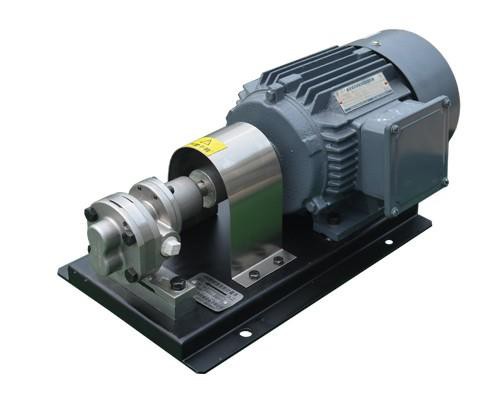
Choosing the right Rotary Gear Pump for your application is crucial. Select a pump with a flow rate and pressure rating that closely matches your system requirements. Oversizing a pump can lead to excessive power consumption, as the pump may be operating at a lower efficiency point. For example, if your system only requires a flow rate of 30 L/min and a pressure of 1 MPa, choosing a pump with a much higher capacity will result in unnecessary power usage. We offer a wide range of pumps, including the Sodium Silicate Furan Resin Methenamine Gear Metering Pump, Polyether Polyols Metering Pump, and Motor Gear Pump, which can be carefully selected according to your specific needs. -
System Design
Optimize the design of your fluid system to reduce resistance. This can include using shorter and larger - diameter pipes, minimizing the number of bends and fittings, and ensuring proper insulation to maintain the fluid's viscosity. A well - designed system will require less pressure to operate, thereby reducing the pump's power consumption. -
Regular Maintenance
Regular maintenance of the Rotary Gear Pump is essential to keep it operating at peak efficiency. This includes checking and replacing worn - out gears, seals, and bearings, as well as ensuring proper lubrication. A well - maintained pump will have lower internal leakage and better mechanical efficiency, resulting in reduced power consumption. -
Variable Speed Drives
Using variable speed drives (VSDs) can significantly reduce power consumption. VSDs allow the pump to adjust its speed according to the actual demand of the system. For example, when the flow rate requirement decreases, the pump speed can be reduced, which in turn reduces the power draw. This is especially useful in applications where the demand for fluid varies over time.
Conclusion
The power consumption of a Rotary Gear Pump is influenced by multiple factors, including flow rate, pressure, fluid viscosity, and pump efficiency. By understanding these factors and taking appropriate measures to optimize them, customers can reduce the operating cost of their systems. As a supplier of Rotary Gear Pumps, we are committed to providing high - quality pumps and technical support to help our customers achieve the best performance and energy efficiency.
If you are interested in learning more about our Rotary Gear Pumps or have specific requirements for your application, please feel free to contact us for procurement and further discussion. We look forward to working with you to find the most suitable pump solutions for your needs.
References
- "Pump Handbook" by Igor J. Karassik, Joseph P. Messina, Paul Cooper, and Charles C. Heald.
- Technical literature from various pump manufacturers on Rotary Gear Pump operation and performance.