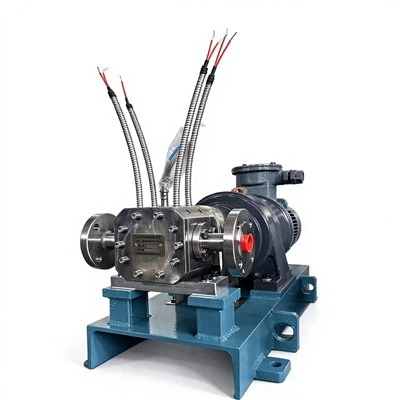
In the field of fluid transfer and metering, magnetic gear pumps have emerged as a reliable and efficient solution for a wide range of applications. As a leading Magnetic Gear Pump supplier, we understand the importance of every component in these pumps, especially the gear profile. The gear profile plays a crucial role in determining the performance of a magnetic gear pump, affecting aspects such as flow rate, pressure, efficiency, and noise levels. In this blog post, we will delve into the influence of the gear profile on the performance of a magnetic gear pump and explore how different profiles can be optimized for specific applications.
Understanding Magnetic Gear Pumps
Before we discuss the influence of the gear profile, let's briefly understand how magnetic gear pumps work. A magnetic gear pump consists of two main parts: the outer magnetic drive and the inner driven gear. The outer magnetic drive is connected to a motor, which provides the rotational force. The inner driven gear is located inside the pump chamber and is magnetically coupled to the outer drive. As the outer drive rotates, it creates a magnetic field that causes the inner driven gear to rotate, pumping the fluid through the pump.
The gear profile is the shape of the teeth on the gears. It is designed to ensure smooth and efficient fluid transfer by meshing the teeth of the driving and driven gears together. The gear profile can vary depending on the application requirements, such as the type of fluid being pumped, the flow rate, and the pressure.
Influence of Gear Profile on Flow Rate
The gear profile has a significant impact on the flow rate of a magnetic gear pump. The flow rate is the volume of fluid that the pump can transfer per unit of time. A well-designed gear profile can maximize the flow rate by minimizing the leakage between the teeth of the gears.


One of the key factors that affect the flow rate is the gear tooth shape. Different tooth shapes, such as involute, cycloidal, and trochoidal, have different characteristics in terms of fluid displacement and leakage. For example, involute gears are widely used in magnetic gear pumps due to their simplicity and ease of manufacturing. They provide a relatively constant flow rate and are suitable for a wide range of applications. Cycloidal and trochoidal gears, on the other hand, can provide higher flow rates and better efficiency, especially in high-viscosity applications.
Another factor that affects the flow rate is the gear module. The gear module is the ratio of the pitch diameter of the gear to the number of teeth. A larger gear module generally results in a higher flow rate, as it allows for a larger volume of fluid to be displaced per revolution of the gears. However, a larger gear module also requires a larger pump size and may increase the cost.
Influence of Gear Profile on Pressure
The gear profile also plays a crucial role in determining the pressure capabilities of a magnetic gear pump. The pressure is the force exerted by the fluid on the walls of the pump and the piping system. A well-designed gear profile can withstand high pressures without excessive leakage or deformation.
The gear tooth shape and the contact ratio between the teeth are important factors that affect the pressure capabilities of the pump. The contact ratio is the number of teeth in contact at any given time. A higher contact ratio generally results in a more stable and efficient operation, as it distributes the load evenly across the teeth. This helps to prevent excessive wear and damage to the gears, especially at high pressures.
In addition, the gear material and the heat treatment process can also affect the pressure capabilities of the pump. High-strength materials, such as stainless steel and alloy steel, are commonly used in magnetic gear pumps to withstand high pressures. The heat treatment process can further improve the hardness and strength of the gears, making them more resistant to wear and deformation.
Influence of Gear Profile on Efficiency
Efficiency is an important consideration in any pump application, as it directly affects the operating cost and the environmental impact. The gear profile has a significant impact on the efficiency of a magnetic gear pump by affecting the power consumption and the fluid losses.
A well-designed gear profile can minimize the power consumption by reducing the friction and the leakage between the teeth of the gears. This can be achieved by optimizing the tooth shape, the clearance between the teeth, and the surface finish of the gears. For example, a smooth surface finish can reduce the friction between the teeth, while a proper clearance can prevent excessive leakage.
In addition, the gear profile can also affect the fluid losses in the pump. Fluid losses can occur due to leakage, recirculation, and turbulence. A well-designed gear profile can minimize these losses by ensuring a smooth and efficient fluid flow through the pump. This can improve the overall efficiency of the pump and reduce the operating cost.
Influence of Gear Profile on Noise Levels
Noise levels are another important consideration in pump applications, especially in environments where noise pollution is a concern. The gear profile can have a significant impact on the noise levels of a magnetic gear pump by affecting the vibration and the noise generated during operation.
A well-designed gear profile can minimize the vibration and the noise by reducing the impact forces between the teeth of the gears. This can be achieved by optimizing the tooth shape, the contact ratio, and the meshing characteristics of the gears. For example, a proper tooth shape can reduce the impact forces during meshing, while a high contact ratio can distribute the load evenly across the teeth, reducing the vibration and the noise.
In addition, the gear material and the lubrication system can also affect the noise levels of the pump. High-quality materials and a proper lubrication system can reduce the friction and the wear between the teeth, resulting in lower noise levels.
Optimizing Gear Profiles for Specific Applications
As a Magnetic Gear Pump supplier, we understand that different applications have different requirements in terms of flow rate, pressure, efficiency, and noise levels. Therefore, we offer a wide range of gear profiles to meet the specific needs of our customers.
For applications that require high flow rates and low pressures, such as chemical transfer and food processing, we recommend using involute gears with a large gear module. These gears provide a relatively constant flow rate and are suitable for a wide range of fluids.
For applications that require high pressures and high efficiency, such as hydraulic systems and oil refining, we recommend using cycloidal or trochoidal gears. These gears can provide higher flow rates and better efficiency, especially in high-viscosity applications.
For applications that require low noise levels, such as pharmaceutical and laboratory equipment, we recommend using gears with a smooth surface finish and a high contact ratio. These gears can reduce the vibration and the noise generated during operation, resulting in a quieter and more comfortable working environment.
Conclusion
In conclusion, the gear profile plays a crucial role in determining the performance of a magnetic gear pump. It affects the flow rate, pressure, efficiency, and noise levels of the pump, and can be optimized for specific applications. As a leading Magnetic Gear Pump supplier, we offer a wide range of gear profiles to meet the specific needs of our customers. Whether you need a pump for high flow rates, high pressures, high efficiency, or low noise levels, we have the right solution for you.
If you are interested in learning more about our Magnetic Gear Pumps or would like to discuss your specific application requirements, please feel free to contact us. Our team of experts will be happy to assist you and provide you with the best possible solution.
Explore Our Product Range
We offer a variety of magnetic gear pumps to suit different applications. Check out our Magnetic Coupling Gear Pump, Heat Preservation Corrosion Resistant Gear Metering Pump, and Gear Pump High Viscosity Material Transfer Gear Metering Pump for more details.
References
- [1] Smith, J. (2018). Gear Pumps: Principles, Design, and Applications. Elsevier.
- [2] Johnson, R. (2019). Magnetic Gear Pumps: A Review of Recent Developments. Journal of Fluid Engineering, 141(6), 061101.
- [3] Brown, T. (2020). Influence of Gear Profile on the Performance of Positive Displacement Pumps. International Journal of Fluid Power, 21(2), 123-132.