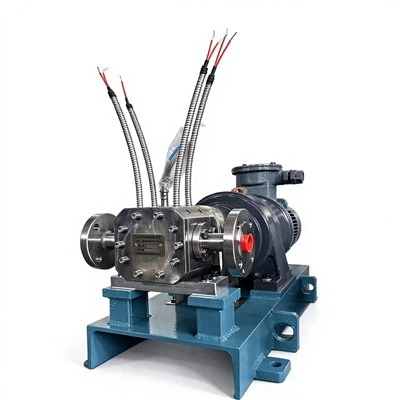
As a supplier of China Rotor Pumps, I am often asked about the torque requirements of these pumps. Understanding the torque requirements is crucial for ensuring the proper operation, efficiency, and longevity of the rotor pumps. In this blog post, I will delve into the details of what the torque requirements of China Rotor Pumps entail and why they are so important.
What is Torque in the Context of Rotor Pumps?
Torque, in the world of mechanical engineering, is the measure of the force that can cause an object to rotate about an axis. In the case of rotor pumps, torque is the rotational force required to turn the rotors within the pump housing. This force is essential for creating the necessary pressure to move fluids through the pump and into the system.
The torque requirement of a rotor pump is influenced by several factors, including the pump's design, the viscosity of the fluid being pumped, the speed of rotation, and the pressure differential across the pump. Each of these factors plays a significant role in determining the amount of torque needed to operate the pump effectively.
Factors Affecting Torque Requirements
Pump Design
The design of the rotor pump has a direct impact on its torque requirements. Different types of rotor pumps, such as external gear pumps, internal gear pumps, and screw pumps, have varying rotor geometries and operating principles. For example, external gear pumps typically have two meshing gears that rotate in opposite directions, while internal gear pumps have an inner and outer gear that rotate in the same direction. These differences in design result in different torque requirements.
The size and shape of the rotors also affect the torque needed to turn them. Larger rotors generally require more torque to rotate due to their increased mass and inertia. Additionally, the clearances between the rotors and the pump housing can influence the torque requirements. Tighter clearances can increase the resistance to rotation, requiring more torque to overcome.
Fluid Viscosity
The viscosity of the fluid being pumped is another critical factor in determining the torque requirements of a rotor pump. Viscosity is a measure of a fluid's resistance to flow. High-viscosity fluids, such as oils and syrups, require more force to move through the pump compared to low-viscosity fluids, such as water.
As the viscosity of the fluid increases, the torque needed to turn the rotors also increases. This is because the pump must work harder to overcome the internal friction of the fluid. For example, a rotor pump designed to pump water may require significantly less torque than the same pump when used to pump a thick oil.
Rotational Speed
The speed at which the rotors rotate also affects the torque requirements of the pump. Generally, as the rotational speed increases, the torque needed to maintain that speed also increases. This is due to the increased centrifugal forces and fluid resistance at higher speeds.
However, the relationship between rotational speed and torque is not always linear. Some pumps may have an optimal speed range where the torque requirements are minimized. Operating the pump outside of this range can result in increased energy consumption and premature wear of the pump components.
Pressure Differential
The pressure differential across the pump, which is the difference between the inlet and outlet pressures, also influences the torque requirements. A higher pressure differential means that the pump must work harder to push the fluid through the system. This requires more torque to turn the rotors and overcome the resistance caused by the pressure difference.
For example, if a rotor pump is used to pump a fluid from a low-pressure tank to a high-pressure pipeline, the pump will need to generate enough torque to overcome the pressure difference between the two points. The greater the pressure differential, the more torque the pump will require.
Calculating Torque Requirements
Calculating the exact torque requirements of a China Rotor Pump can be a complex process that requires a detailed understanding of the pump's design, the fluid properties, and the operating conditions. However, there are some general guidelines and formulas that can be used to estimate the torque requirements.
One common method is to use the following formula:
[ T = \frac{P}{\omega} ]
Where:
- ( T ) is the torque (in Newton-meters, Nm)
- ( P ) is the power required to operate the pump (in Watts, W)
- ( \omega ) is the angular velocity of the rotors (in radians per second, rad/s)
The power required to operate the pump can be calculated using the following formula:
[ P = \frac{Q \times \Delta P}{\eta} ]
Where:
- ( Q ) is the flow rate of the fluid (in cubic meters per second, m³/s)
- ( \Delta P ) is the pressure differential across the pump (in Pascals, Pa)
- ( \eta ) is the efficiency of the pump
It's important to note that these formulas provide only an estimate of the torque requirements. In practice, other factors such as mechanical losses, fluid friction, and operating conditions can affect the actual torque needed. Therefore, it's always recommended to consult with a pump manufacturer or a qualified engineer to determine the exact torque requirements for a specific application.


Importance of Meeting Torque Requirements
Meeting the torque requirements of a China Rotor Pump is essential for several reasons. First and foremost, it ensures the proper operation of the pump. If the torque supplied to the pump is insufficient, the rotors may not rotate at the required speed, resulting in reduced flow rates and pressure output. This can lead to poor system performance and even system failure.
On the other hand, if the torque supplied is excessive, it can cause unnecessary wear and tear on the pump components. The increased stress on the rotors, bearings, and seals can lead to premature failure and costly repairs. Additionally, excessive torque can also result in increased energy consumption, which can drive up operating costs.
Our China Rotor Pump Offerings
At our company, we offer a wide range of China Rotor Pumps that are designed to meet the diverse needs of our customers. Our pumps are available in various sizes, configurations, and materials to suit different applications and operating conditions.
Some of our popular rotor pump models include the Sodium Silicate Furan Resin Methenamine Gear Metering Pump, the B Series Epoxy Resin Universal Gear Metering Pump, and the Polyether Polyols Metering Pump. These pumps are known for their high efficiency, reliability, and precise metering capabilities.
We understand the importance of torque requirements in the operation of rotor pumps. That's why our pumps are carefully engineered and tested to ensure that they meet the specified torque requirements for each application. Our team of experts can help you select the right pump for your needs and provide you with accurate torque calculations based on your specific requirements.
Contact Us for Procurement and Consultation
If you are in the market for a China Rotor Pump or need more information about torque requirements, we encourage you to contact us. Our experienced sales team is ready to assist you with your procurement needs and provide you with detailed technical support.
Whether you have a specific application in mind or need help selecting the right pump for your project, we are here to help. We can provide you with product specifications, performance data, and pricing information to help you make an informed decision.
Don't hesitate to reach out to us today to start the conversation about your rotor pump requirements. We look forward to working with you and helping you find the perfect solution for your pumping needs.
References
- "Pump Handbook" by Igor J. Karassik, Joseph P. Messina, Paul Cooper, and Charles C. Heald
- "Mechanical Engineering Design" by Joseph E. Shigley and Charles R. Mischke
- "Fluid Mechanics" by Frank M. White