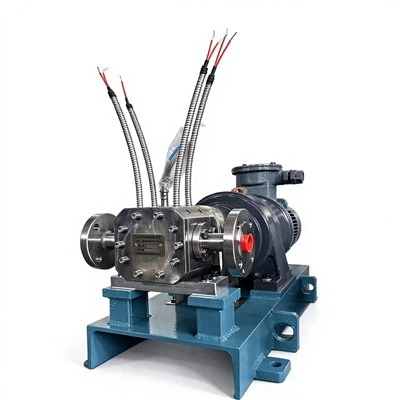
As a trusted Universal Gear Pump supplier, I understand the significance of flow control in the efficient operation of these pumps. Flow control is crucial for ensuring that the pump delivers the right amount of fluid at the appropriate pressure, which is essential for various industrial applications. In this blog post, I will discuss the different types of flow control methods available for Universal Gear Pumps, providing insights into their mechanisms, advantages, and applications.
1. Throttle Control
Throttle control is one of the simplest and most commonly used flow control methods for Universal Gear Pumps. This method involves adjusting the flow rate by restricting the outlet of the pump. By using a throttle valve, the cross - sectional area of the outlet passage is reduced, which in turn increases the resistance to flow. As a result, the flow rate of the fluid through the pump decreases.
The main advantage of throttle control is its simplicity. It is easy to implement and does not require complex control systems. However, this method has some limitations. When the throttle valve restricts the flow, it causes an increase in pressure upstream of the valve. This increased pressure can lead to higher energy consumption as the pump has to work harder to overcome the resistance. Additionally, excessive throttling can cause cavitation in the pump, which can damage the pump components over time.
Throttle control is suitable for applications where the flow rate needs to be adjusted over a relatively small range and where energy efficiency is not the primary concern. For example, in some small - scale industrial processes where the pump is used intermittently and the load variations are not significant, throttle control can be a cost - effective solution.
2. Bypass Control
Bypass control is another popular flow control method for Universal Gear Pumps. In this method, a bypass line is installed parallel to the main flow path. A bypass valve is used to divert a portion of the fluid from the pump outlet back to the pump inlet. By adjusting the opening of the bypass valve, the amount of fluid that is recirculated can be controlled, thereby regulating the flow rate in the main system.
One of the key advantages of bypass control is that it maintains a relatively constant pressure in the pump. Since the excess fluid is diverted back to the inlet, the pump does not have to operate against a high - pressure differential, which reduces the risk of cavitation. Moreover, bypass control can be more energy - efficient than throttle control in some cases, especially when the pump is required to operate at a lower flow rate for an extended period.
However, bypass control also has its drawbacks. The recirculation of fluid can cause heating of the fluid, which may not be desirable in some applications. Also, the installation of a bypass line and valve adds to the complexity and cost of the system.
Bypass control is commonly used in applications where a constant pressure needs to be maintained, such as in hydraulic systems. For instance, in a hydraulic press, bypass control can ensure that the pump provides a stable pressure to the press while allowing for adjustments in the flow rate as needed.
3. Variable - Speed Control
Variable - speed control is a more advanced flow control method for Universal Gear Pumps. This method involves adjusting the speed of the pump motor to change the flow rate of the pump. By using a variable - frequency drive (VFD), the electrical frequency supplied to the motor can be varied, which in turn changes the motor speed.
The main advantage of variable - speed control is its high energy efficiency. Since the power consumption of a pump is proportional to the cube of its speed, reducing the pump speed can significantly reduce energy consumption. For example, if the pump speed is reduced by 20%, the power consumption can be reduced by approximately 50%. Additionally, variable - speed control allows for precise control of the flow rate over a wide range, which is ideal for applications with varying load requirements.
However, variable - speed control also has some limitations. The initial cost of installing a VFD is relatively high compared to other flow control methods. Moreover, the VFD may introduce electrical noise into the system, which requires proper shielding and grounding to prevent interference with other electrical equipment.


Variable - speed control is widely used in large - scale industrial applications where energy savings are a priority and where precise flow control is required. For example, in water treatment plants, variable - speed control can be used to adjust the flow rate of the pump according to the water demand, resulting in significant energy savings over time.
4. Swash - Plate Control (for Axial Piston Pumps within Universal Gear Pump Systems)
Although Universal Gear Pumps are typically fixed - displacement pumps, in some more complex systems that incorporate axial piston pumps as part of the overall setup, swash - plate control can be used for flow control. In an axial piston pump, the swash plate is a key component that determines the stroke length of the pistons. By changing the angle of the swash plate, the displacement of the pump can be adjusted, which in turn changes the flow rate.
The advantage of swash - plate control is its ability to provide a wide range of flow rates with relatively high efficiency. It allows for precise control of the flow rate and can respond quickly to changes in the load. However, swash - plate control systems are more complex and expensive to manufacture and maintain compared to other flow control methods.
Swash - plate control is commonly used in high - performance hydraulic systems, such as those in aircraft and heavy - duty construction equipment, where precise and rapid flow control is essential.
Product Recommendations
As a Universal Gear Pump supplier, we offer a wide range of high - quality pumps suitable for different applications. Our Cast Iron Pump AB Glue Gear Metering Pump is designed for precise metering of glue and other viscous fluids. It can be paired with various flow control methods to ensure accurate and stable flow rates.
Our Gear Metering Pump With High Precision is ideal for applications where high - accuracy flow control is required. It can be used in chemical processing, food and beverage production, and other industries where precise dosing of fluids is crucial.
For applications involving corrosive fluids, our Stainless Steel Sodium Silicate Gear Metering Pump is a great choice. Its stainless - steel construction provides excellent corrosion resistance, and it can be combined with appropriate flow control mechanisms to meet the specific requirements of the application.
Conclusion
In conclusion, there are several types of flow control methods available for Universal Gear Pumps, each with its own advantages and limitations. Throttle control is simple but may be less energy - efficient. Bypass control can maintain constant pressure but may cause fluid heating. Variable - speed control offers high energy efficiency and precise control but has a high initial cost. Swash - plate control, although mainly applicable in more complex systems, provides a wide range of flow rates with high efficiency.
When selecting a flow control method for your Universal Gear Pump, it is important to consider factors such as the required flow rate range, energy efficiency, system complexity, and cost. As a supplier, we are committed to helping you choose the most suitable pump and flow control solution for your specific application. If you are interested in our products or need more information about flow control for Universal Gear Pumps, please feel free to contact us for procurement and further discussions.
References
- Hydraulic Pump Handbook, various authors, published by Hydraulic Press.
- Industrial Pump Systems: Design, Operation, and Maintenance, by John Smith, published by Industrial Press.
- Fluid Power Engineering, by Robert Johnson, published by Engineering Press.