


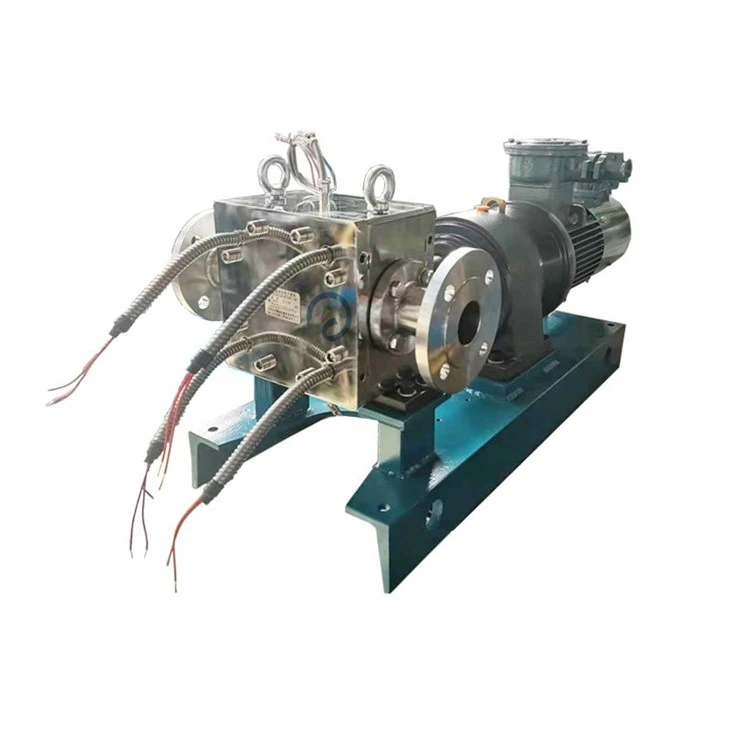
Heat Preservation Gear Pump
Why choose us
Company strength
Our company covers an area of 26,000 square meters, with 5 CNC machining centers; 6 CNC lathes; 6 CNC milling machines; 5 CNC grinders; and 30 other CNC equipment.
Professional team
We have an excellent and experienced workforce capable of providing customers with high-quality products, professional technical consultation and comprehensive services.
Our certifications
Now it has more than 20 patents, passed ISO9000 certification, and its products have passed CE certification.
Advanced equipment
Our company has advanced production and testing equipment to provide you with the best products.
What is Heat Preservation Gear Pump
A heat preservation gear pump is a rotary positive displacement pump that can be of two designs -internal eccentric or external (also known as helical gear).the design chosen for a process is dependent on the viscosity of the fluid and pressure required as the internal design is altered according to fluid type with differing styles of teeth fitted to suit conditions which limits rotational speed.they are very versatile being self-priming up to 6.5m, positive displacement generating non-pulsating flow and handling viscosities between 1 CST and 1,000,000 CST.


Benefits of Heat Preservation Gear Pump

Easy to use and maintain
The Heat Preservation Gear Pump is compact and consists of only two gears, the pump body and the front and rear covers. Therefore, compared with other pumps, the gear pump has a small weight, which is convenient for daily transportation and does not require much labor. It is also because of its light weight, the gear pump is more convenient to use, and it is more convenient when the work content is the same. At the same time, because of its simple structure and fewer components, it is more convenient to repair when problems are encountered.

Low cost
Compared with the conventional pump, the Heat Preservation Heat Preservation Gear Pump is smaller in weight and easy to transport, which saves transportation costs to some extent. In addition, the Heat Preservation Gear Pump is cheaper because of its simple structure and lower manufacturing cost. The maintenance procedure is simple in the future and the maintenance cost is low. Therefore, in general, Heat Preservation Gear Pump are more economical and can effectively save costs.

High work efficiency
In fact, the fluid loss in the Heat Preservation Gear Pump is small. Although some of the fluid is used to lubricate both sides of the bearing and gear, the pump body can never be fitted without clearance, resulting in a Heat Preservation Gear Pump operating efficiency of 100%. However, the pump can still operate well and can achieve an efficiency of 93% to 98%.

Insensitive to fluid viscosity and density
If the viscosity or density of the fluid changes, the Heat Preservation Gear Pump will not be affected too much. If a strainer or a restrictor is placed on the side of the discharge port, the Heat Preservation Gear Pump will push the fluid through them. If the filter is dirty or clogged, the Heat Preservation Gear Pumpp will still maintain a constant flow until it reaches the mechanical limit of the weakest part of the unit. This also causes the Heat Preservation Gear Pump to be insensitive to oil contamination and is more suitable for use in petrochemical industries.
Application of Heat Preservation Gear Pump
Automotive: Gear pumps are used for hydraulic power steering, oil circulation, and fuel injection.
Oil & Gas: Gear pumps are used in this industry for fluid injection, transfer, and metering.
Chemical: Gear pumps are used to transfer organic and inorganic chemicals. They carry and meter chemicals, oils, and liquids.
Food and Beverage: Manufacturers in the food and beverage industry use gear pumps to pump food-grade liquids like: sauces, chocolate, and syrups. Gear pumps prevent food items with oil, glycerin, and fat from getting stuck.
Pharmaceutical: Pharmaceuticals use gear pumps for handling sensitive materials, liquid transfer, and precise metering.
Pulp and Paper: Gear pumps in the pulp and paper industry pump caustic soda, slurries, resin, sulfate soap, etc.
Plastics and Polymer: The plastic and polymer industry uses gear pumps to build pressure and empty reactors.
Types of Heat Preservation Gear Pump
Cartridge Mechanical Seal Heat Preservation Pump
Cartridge mechanical seal heat preservation pump adopts a mechanical seal as per customer requirements to improve the sealing reliability of the product. The use of mechanical seal helps in easy transportation of materials that tend to thicken easily at room temperature. With the adoption of the mechanical seal, the cartridge mechanical seal heat preservation pump becomes more efficient, reliable, and easy to operate.
Double Wall External Gear Metering Pump
Double wall external gear metering pump is designed for conveying the medium thickened, solidification or crystallization under normal temperature, and maintained a certain temperature and easy flow, such as asphalt, paraffin wax, rosin, heavy oil, resin and similar liquid.

Thermal Insulation External Gear Metering Pump
Our company produces a range of high-quality thermal insulation pumps, designed to transport liquids while keeping them at the desired temperature. These pumps are commonly used in a variety of industrial applications, including chemical and pharmaceutical manufacturing, oil refining, and food processing.
Spiral Lever Heat Preservation Pump
Effectively combine the advantage of gear pumps and screw levers to enhance the function of the heat preservation pump and expand the scope of use.Accurately measure the accuracy of the meduim and the flow is stable.Continuous and stable flow can be operated under different temperature,pressure and viscosity conditions.The pump head has a simple structure, and the moving parts are hardened.Diffierent materials can achieve wear resisitance , corrosion resisitance of different media to ensure long service life.
The Heat Preservation Gear Pump adopts involute gears or arc gears. Generally have a safety valve. Gear oil pump is suitable for conveying lubricating and non-corrosive oils and other liquid media, and suitable for conveying high-lift media. The gear oil pump is lubricated by the conveyed medium. The advantage is that the medium is not demanding. The general pressure does not exceed 6MPa. It has the characteristics of self-priming, uniform flow and reliable operation.

Components of Heat Preservation Gear Pump
Inlet Section
This part of the pump receives liquid into the pump. It is connected to the pump's main housing, where the gears are located.
Prime Mover
A gear pump uses this to drive the shaft containing the power gear. This can be powered by an electric motor, IC engine, or manually.
Drive Gear
The power gear, or driver, is connected to the prime mover. The pump's main motor causes the gear to rotate.
Idler
The idler, also called the driven gear, meshes with the driver gear and also rotates inside the pump.
Housing
The housing of the pump contains both the driver gear and the idler.
Outlet Section
The outlet section of a gear pump is the part of the pump where liquid exits the mechanism.
Pressure Relief Valve
There is a safety valve installed on the pump's outlet section that can release fluid if there is excess pressure to prevent any damage to the pump.
How to Choose Heat Preservation Gear Pump
Flow rate and pressure
The flow rate is the amount of fluid that can be pumped per unit of time. The pressure is the force exerted on the liquid by the pump. Lobe and gear pumps can pump various flow rates and pressures. However, lobe pumps are typically better suited for high flow rates and low pressures. In contrast, gear pumps generally are better suited for low flow rates and high pressures.
Viscosity and temperature
The viscosity of a fluid is a measure of its thickness. The temperature of a liquid is a measure of its heat. Lobe and gear pumps can pump a wide range of viscosities and temperatures. However, lobe pumps are typically better suited for pumping fluids with high viscosities and low temperatures. In contrast, gear pumps generally are better suited for pumping liquids with low viscosities and high temperatures.
Material compatibility
The material compatibility of a pump is a measure of how well the pump can be used to pump a particular fluid. Lobe pumps and gear pumps can be made from a variety of materials. The material chosen for a pump will depend on the type of fluid the pump will be used to pump.
Noise and vibration
The noise and vibration of a pump are measures of how much noise and vibration the pump produces. Lobe pumps and gear pumps can have different amounts of noise and vibration. The noise and vibration of a pump will depend on the design of the pump and the type of fluid that the pump is used to pump.
Efficiency and energy use
The efficiency of a pump is a measure of how much energy is used to pump a particular amount of fluid. The energy use of a pump will depend on the design of the pump and the type of fluid that the pump is used to pump.
How To Start A Heat Preservation Gear Pump?
Check and Prepare
Before starting the Heat Preservation Gear Pump, perform a visual inspection to ensure that the pump and surrounding area are clear of any obstructions or hazards. Check hydraulic pump internals for signs of leakage, damage or wear.Next, make sure the pump is properly connected to the power source and that all electrical connections are secure. If the pump is driven by an engine or motor, make sure the power source is in good working order and properly calibrated.
Start the pump (if necessary)
In some cases, a mini Heat Preservation Gear Pump may need to be primed to move fluid efficiently. Priming involves filling the pump chamber with liquid to eliminate any air pockets and create a vacuum for efficient pumping.To prime the pump, locate the priming port or valve on the pump casing. Open the filling port and pour the appropriate type and amount of liquid into the pump chamber until it is filled to the desired level.
Once the pump chamber is properly primed, securely close the prime port or valve to prevent fluid leakage.
Lubrication
Proper lubrication is critical to the smooth operation and longevity of your Heat Preservation Gear Pump. Before starting the pump, make sure all lubrication points are properly lubricated or oiled according to the manufacturer's instructions.Check the lubrication system to make sure it is operating properly and that there are no leaks or blockages in the lubrication lines.
Turn on the computer
After completing the inspection, start-up (if necessary) and lubrication steps, it is time to turn on power to the Heat Preservation Gear Pump.If the pump is electric, turn on the power and start the pump motor according to the manufacturer's instructions. If the pump is engine driven, start the engine and engage the pump drive mechanism.
Monitor operations
Once the pump is powered on, carefully monitor its operation to ensure everything is running smoothly. Watch for any unusual noises, vibrations, or leaks that may indicate potential problems with the pump.Check the pressure and flow of the pumped fluid using appropriate gauges or instruments to ensure they are within the required ranges.
Tuning and Troubleshooting
If any problems occur during pump startup, such as unusual noises or performance fluctuations, take immediate steps to diagnose and correct the problem.Refer to the pump operating manual or consult a qualified technician for guidance on troubleshooting and making necessary adjustments.
Close the program
Once a Heat Preservation Gear Pump has been successfully started and operating as expected, proper shutdown procedures must be followed when no longer needed.Gradually reduce the speed or power input of the pump to bring it to a gradual stop and prevent damage from sudden stops.If the pump requires maintenance or repair, follow the manufacturer's recommendations for shutdown procedures and safety precautions.
How to Maintain Heat Preservation Gear Pump
Regular Maintenance
Regular maintenance is the key to ensuring the longevity of your Heat Preservation Gear Pump. Proper maintenance includes checking the oil levels, cleaning the pump, and inspecting the gears, bearings, and shafts. It is recommended to follow the manufacturer's guidelines for maintenance.
Inspect the Seals
The seals in the Heat Preservation Gear Pump play a crucial role in preventing leakage. It is important to inspect the seals regularly and replace them if they show signs of wear and tear.
Check the Motor
The motor is an important component of the Heat Preservation Gear Pump, and it is important to ensure that it is functioning properly. Check the motor regularly for any signs of wear or damage, and replace it if necessary.
Monitor the Temperature
Monitoring the temperature of the Heat Preservation Gear Pump is important to prevent overheating, which can damage the pump. Make sure that the pump is not operating at high temperatures, and check the cooling system to ensure that it is functioning properly.
Troubleshooting Common Issues
Despite proper maintenance,Heat Preservation Gear Pump can sometimes experience issues such as leaks, low flow rates, and unusual noises. To troubleshoot these issues, it is recommended to consult the manufacturer's guidelines and seek professional help if necessary.
Our Factory
Jinan Hai Rui Te Mechanical CO., LTD was founded in 2005. Our talented and experienced staff can provide products with good quality, professional technical consult, and perfect service to our clients. "Keep improving " is a principle we always insist. More than sixty percent of the company staff have bachelor or higher university degrees. Now We have more than 20 patents, passed ISO9000 certification, and our products have passed CE certification. As a professinal fluid service provider, we only manufacture and sell quality products. Clients can rest assured our products and services will solve all their fluid metering problems efficiently and economically.
Certificate


