


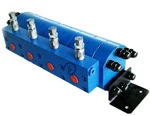
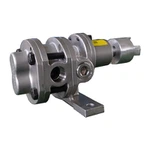
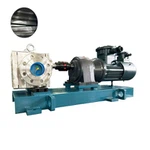
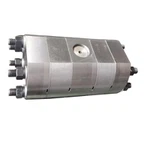
Universal Gear Pump
Why choose us
Company strength
Our company covers an area of 26,000 square meters, with 5 CNC machining centers; 6 CNC lathes; 6 CNC milling machines; 5 CNC grinders; and 30 other CNC equipment.
Professional team
We have an excellent and experienced workforce capable of providing customers with high-quality products, professional technical consultation and comprehensive services.
Our certifications
Now it has more than 20 patents, passed ISO9000 certification, and its products have passed CE certification.
Advanced equipment
Our company has advanced production and testing equipment to provide you with the best products.
What is Universal Gear Pump
Universal gear pumps are one of the most popular types of positive displacement pumps. They tend to be compact in size and have minimal moving parts.they utilize gears, sometimes called rotating cogs, to transfer fluids. The two gears produce a seal and creates suction to the inlet side, fluid is drawn into the pump and then the gears rotate moving the liquid to the outlet port. As the gears rotate they separate on the intake side of the pump, creating a void and suction which is filled by fluid.


Universal gear pump with the good fluid compatibility, is widely used in different industries,
and which shows excellent preformance except acidic, strong alkaline, and chloride fluid.
Specially for the isocyanate, polyether polyols, two components A and B, epoxy resin or sodium silicate
Benefits of Universal Gear Pump
Precise flow control
Universal gear pumps are known for their ability to provide accurate and consistent flow rates. Offering unrivaled control over the flow of fluids, gear pumps are suitable for applications requiring tight process control.
Compact size
Depending on the model type, universal gear pumps are relatively compact. Their small footprint supplies an advantage in low flow processing when space might be limited. The innovative design allows for easy integration of gear pumps into existing systems or installation in tight spaces.
Self-priming capability
Universal gear pumps are self-priming, meaning they create a suction to draw fluid into the pump without the need for additional priming mechanisms. If you need to maintain a steady flow of fluid, then self-priming is not a luxury, it is essential.
High efficiency
Universal gear pumps achieve high volumetric efficiency, minimizing energy consumption and reducing operating costs. Their efficiency is particularly advantageous in processes where energy efficiency is a priority.
Low shear
Universal gear pumps generate minimal shear forces on the pumped fluid, making them suitable for handling shear-sensitive materials or delicate substances. Low flow is advantageous when it involves sensitive fluids or products that cannot suffer damage or degradation.
Wide range of compatible fluids
Gear pumps are compatible with countless fluids, from ultrathin to highly viscous liquids, leveraging their versatility in various low flow applications across different industries. Gear pump features and capabilities
Application of Universal Gear Pump
Chemical industry
Gear pumps are widely used in the chemical industry to handle various chemicals, including corrosive and abrasive substances. Their ability to handle high pressures and maintain a consistent flow makes them ideal for transferring chemicals in manufacturing processes.
Oil and gas industry
Universal gear pumps play a crucial role in the oil and gas industry for applications such as fuel transfer, lubrication, and hydraulic systems. They are capable of handling different types of oils, fuels, and lubricants, making them essential in maintaining the smooth operation of machinery and equipment.
Food and beverage industry
Universal gear pumps are used in the food and beverage industry for transferring viscous fluids such as syrups, chocolate, and sauces. Their gentle pumping action ensures that delicate food products are not damaged during the transfer process.
Automotive industry
Universal gear pumps are utilized in automotive applications for tasks such as engine lubrication, transmission fluid circulation, and fuel transfer. They provide reliable and consistent fluid flow, contributing to the efficient operation of vehicles.
Pharmaceutical industry
Universal gear pumps are employed in the pharmaceutical industry for the transfer of various liquids, including medications, solvents, and suspensions. Their sanitary design and ability to handle different viscosities make them suitable for pharmaceutical processes.
Agriculture and irrigation
Universal gear pumps are used in agricultural applications for tasks such as fertilizer spraying, pesticide application, and irrigation. Their ability to handle different types of fluids and generate high pressures makes them valuable for efficient agricultural practices.
Types of Universal Gear Pump
GP1 Gear pumps
These pumps achieve a displacement volume of one to 9.8 cubic centimeters per rotation. In addition, they impress with high operational reliability and long service life. The GP1 gear pumps belong to our latest generation of pumps with improved efficiency and reduced noise. All models are made of a high-quality aluminum alloy and are available with various connection arrangements and dimensions. Multiple pumps are also available if required.
GP2 Gear pumps
For a slightly larger displacement volume, you can choose the GP2 gear pumps. The series achieves a displacement volume of 4.5 to 32 cubic centimeters with each rotation. Gearwheels with twelve teeth each operate in the slightly larger housings for this purpose. As a result, the GP2 series operates with above-average quietness. The housing made of a high-quality aluminum alloy is complemented by a cast iron cover and flange for extra durability.
GP3 Gear pumps
In this series you will find gear pumps with a displacement volume between 22.5 and 60 m3/rev. It is manufactured as robust and durable as the other series.

Components of Universal Gear Pump
Housing or Casing
The housing, often made of metal or cast iron, contains the other components of the gear pump and provides structural support. It also includes inlet and outlet ports for fluid flow.
Gears
Gear pumps have two main gears that are typically of the same size. One gear is the driving gear, connected to a motor or an engine, and the other is the driven gear. These gears are precisely machined and have well-defined teeth that mesh together as they rotate.
Shafts
Shafts connect the gears to the drive source (e.g., an electric motor or an internal combustion engine). The driving gear is mounted on the input shaft, while the driven gear is mounted on the output shaft. The shafts transmit rotary motion from the drive source to the gears.
Bearings
Bearings support the shafts and reduce friction between moving parts, allowing for smooth rotation. Proper bearing lubrication is essential to prevent wear and overheating.
Inlet and Outlet Ports
The pump housing has inlet and outlet ports that allow fluid to enter and exit the pump. The design and placement of these ports depend on the specific application and requirements.
Seals and Gaskets
Seals and gaskets are used to prevent fluid leakage from the pump. They are placed at various points within the pump, including around the gears and shafts.
The Operation of a Gear Pump Can Be Broken Down Into Several Steps

Inlet Phase
When the gears begin to rotate, fluid is drawn into the pump through the inlet port. As the gears continue to turn, the space between the gear teeth and the pump housing increases, creating a low-pressure area that allows fluid to flow in.

Outlet Phase
Once the fluid reaches the outlet side, it is pushed out of the pump through the outlet port. The meshing of the gears and the reduction in volume between the gear teeth and the housing force the fluid out of the pump.

Transport Phase
As the gears rotate further, the fluid becomes trapped in the spaces between the gear teeth and the housing. The rotating gears carry the trapped fluid from the inlet side to the outlet side.

Repeating Cycle
This process repeats with each rotation of the gears, resulting in a continuous flow of fluid. The volume of fluid moved per rotation is determined by the size and geometry of the gears.
Some Practical Skills Of Gear Pump Maintenance
When the driving shaft and bushing of the gear pump are worn, the matching clearance will increase, which will inevitably affect the oil volume of the pump. In this case, the normal fit clearance can be restored by repairing the driving shaft or bushing. If the driving shaft is slightly worn, just press out the old bushing and replace it with a standard bushing, and the fit clearance can be restored to the allowable range. If the driving shaft and bushing are seriously worn and the fit clearance exceeds the standard, not only the bushing shall be replaced, but also the diameter of the driving shaft shall be increased by chromium plating or vibration surfacing, and then ground to the standard size to restore the fit requirements with the bushing.
Shell cracks can be repaired with cast 508 nickel copper welding rod. The weld must be tight and free of air holes, and the flatness error of the joint surface with the pump cover shall not be greater than 0.05mm.
Repair of working plane: If the working plane of the pump cover is slightly worn, the wear trace can be eliminated by manual grinding, that is, put a little valve sand on the platform or thick glass plate, and then put the pump cover on it for grinding until the wear trace is eliminated and the working surface is flat. When the wear depth of the working plane of the pump cover exceeds 0.1mm, it shall be repaired by turning first and then grinding.
The gear wear of gear pump is mainly at the tooth thickness, while the wear of gear end face and tooth top is relatively light. The gear is worn on one side at the tooth thickness, so the gear can be turned 180 degrees for use. When the gear end face is worn, the end face can be ground flat, and the joint surface of the lubricating oil pump housing can be ground at the same time to ensure that the clearance between the gear end face and the pump cover is within the standard range.
Our Factory
Jinan Hai Rui Te Mechanical CO., LTD was founded in 2005. Our talented and experienced staff can provide products with good quality, professional technical consult, and perfect service to our clients. "Keep improving " is a principle we always insist. More than sixty percent of the company staff have bachelor or higher university degrees. Now We have more than 20 patents, passed ISO9000 certification, and our products have passed CE certification. As a professinal fluid service provider, we only manufacture and sell quality products. Clients can rest assured our products and services will solve all their fluid metering problems efficiently and economically.
Certificate


FAQ