




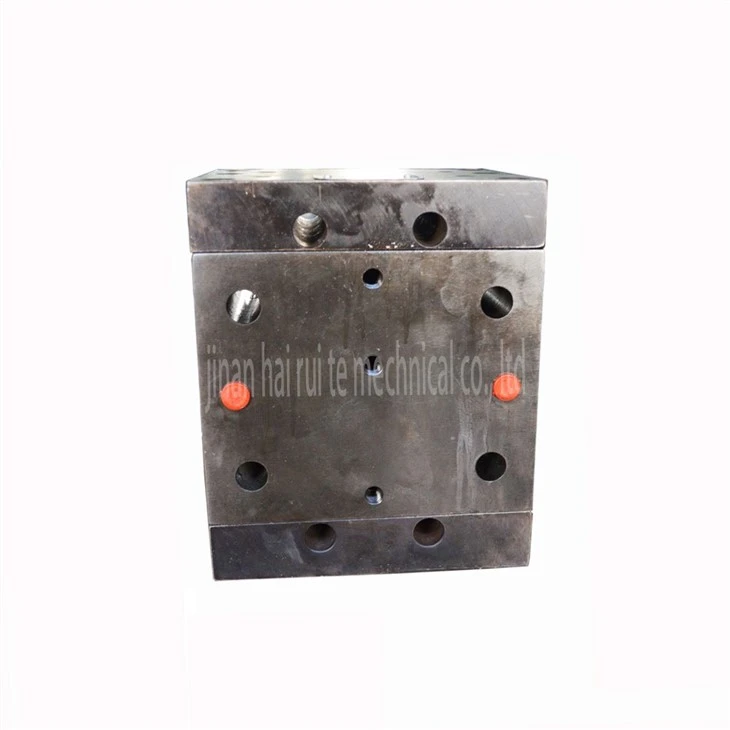
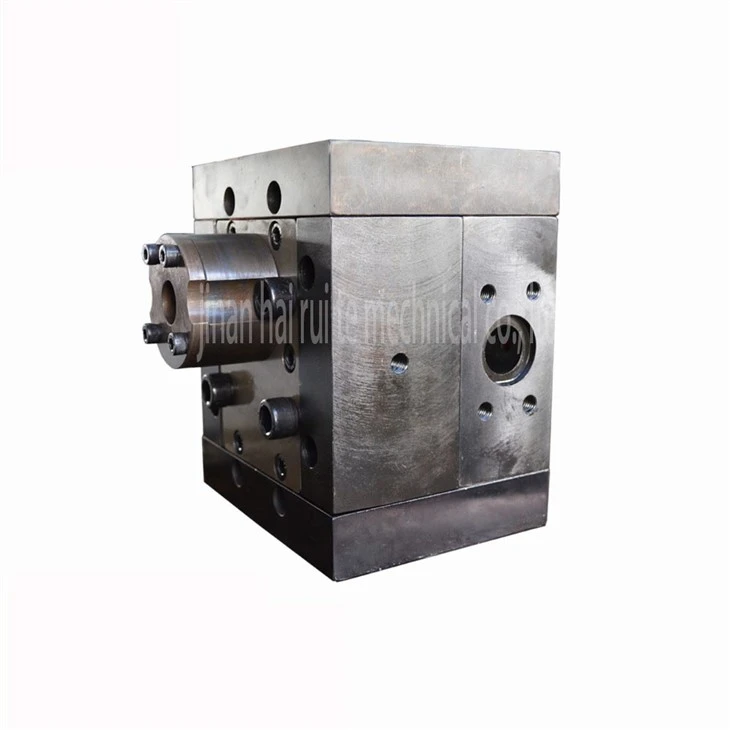

Melt Blown Pump
Melt blown pumps are mainly used for pressurization and stable flow delivery of extruders or medium and high viscosity polymers. The heating method is mainly electric heating. Suitable for PS, PP, PET, PVC, PC, PMMA, PA, ABS, PE-LLD and other processes.

1. Pump body: Nitrided steel (temperature resistance 300℃+, wear resistance HRC60+) or high-temperature alloy, suitable for long-term high-temperature operating conditions.
2. Gears: 20CrMnTi carburized and quenched or powder metallurgy, with gear surface accuracy of grade 6 or higher, reducing melt shearing and leakage.
3. Bearings: Hard alloy or silicon carbide, suitable for self-lubrication by the melt, wear-resistant and corrosion-resistant.
4. Heating and temperature control: Segmented electric heating tubes + PT100 sensors, supporting PID constant temperature control to prevent localized overheating and material degradation.

1. Structure: Composed of a pump body, main/driven gears, self-lubricating sliding bearings, front and rear end plates, electric heating jacket, and sealing system; the drive system typically uses a "motor + reducer + universal coupling" to ensure stable output of low speed and high torque.
2. Metering and Conveying: Gear meshing increases the volume of the suction chamber, creating negative pressure to draw in the melt; the volume on the meshing side decreases, compressing and discharging the melt. The flow rate is linearly related to the rotational speed, facilitating precise flow control.
3. Temperature Control and Lubrication: The pump body features an electric heating jacket and insulation layer, controlling the temperature between 180℃ and 280℃ with a fluctuation of ≤±2℃; the bearings are self-lubricated by the melt, preventing contamination of the raw materials.
4. Sealing Solution: Commonly uses mechanical seals or magnetic seals, suitable for high-pressure and high-temperature conditions, preventing melt leakage.

Wear and clogging: Strictly control the cleanliness of raw materials and install melt filters; regularly inspect gear/bearing wear and replace them promptly.
Temperature fluctuations: Calibrate temperature sensors, check heating elements and insulation layers to prevent localized solidification.
Leakage treatment: Regularly replace seals, ensure coaxial alignment during installation, and reduce shaft seal wear.

Melt Blown Pump Performance Parameter Table
| Type | single displacement (cc/rev) | high rotation (rpm) | output (KG/24H) | Screw specification (reference) | width of pp melt blown (mm) |
| UK-P-9CC | 9 | 45 | 150-450 | φ45/50 | 600 |
| UK-P-10CC | 10 | 45 | 165-500 | φ45/50 | 600 |
| UK-P-20CC | 20 | 45 | 330-1000 | φ65 | 1200 |
| UK-P-25CC | 25 | 45 | 400-1250 | φ65 | 1200 |
| UK-P-30CC | 30 | 45 | 500-1500 | φ90 | 1600 |
| UK-P-50CC | 50 | 45 | 800-2500 | φ105 | 2400 |
| UK-P-70CC | 70 | 45 | 1100-3500 | φ105 | 2400 |
| UK-P-100CC | 100 | 45 | 1600-5000 | φ120 | 3200 |
Hot Tags: melt blown pump, China, manufacturers, suppliers, price, Rotary Gear Pump With Motor, Geared Flow Dividers With Relief Valve, Gear Pump With Motor, Rotor Pump, Gear Metering Pump, CAM Rotor Pump
You Might Also Like


Send Inquiry